Table of Contents
- Key Takeaways
- Quick Verdict
- Product Overview & Specifications
- Real-World Performance & Feature Analysis
- Design & Build Quality
- Performance in Real Use
- Ease of Use
- Durability & Reliability
- Pros & Cons
- Comparison & Alternatives
- Cheaper Alternative: Crayola Color Wonder
- Premium Alternative: AQUA Doodle Travel Mat
- Buying Guide / Who Should Buy
- Best For Beginners
- Best For Specific Use Cases
- Not Recommended For
- FAQ
As a parent who’s cleaned paint off walls, furniture, and once even the family dog, the promise of “mess-free painting” sounds almost too good to be true. When my three-year-old brings home artwork from preschool, I brace for the inevitable colorful stains that seem to appear everywhere except the actual paper. The MINDNOOK Magic Brush Painting Set claims to solve this universal parenting problem with technology that only reveals colors on special paper. But does it actually work in real life, or is it just another gimmick that disappoints when you actually use it?
Key Takeaways
- The magic technology works surprisingly well – colors truly don’t transfer to skin, clothes, or furniture under normal use
- Limited paper is the biggest constraint – 16 double-sided sheets means creative sessions have a clear end point
- Best for travel and contained spaces – ideal for cars, restaurants, and small apartments where traditional paint would be disastrous
- Not a replacement for traditional art – the sensory experience differs significantly from real paint and brushes
- Age range is accurate – works well for 3-6 year olds, but older kids may find it limiting
Quick Verdict
Best for: Parents of toddlers and young children (3-6 years) who need contained creative activities for travel, small spaces, or situations where traditional paint would cause too much mess.
Not ideal for: Families seeking unlimited creative sessions, sensory-rich art experiences, or children over 7 who need more complexity.
Core strengths: Genuinely mess-free technology, excellent portability, contained creative play with clear start and end points, good variety of tools in one kit.
Core weaknesses: Limited paper supply, colors appear slightly faded compared to traditional paint, not the same tactile experience as real art materials.
Product Overview & Specifications
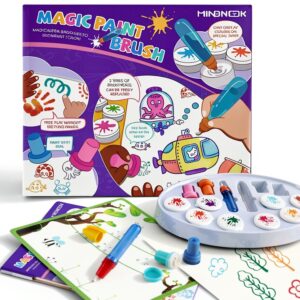
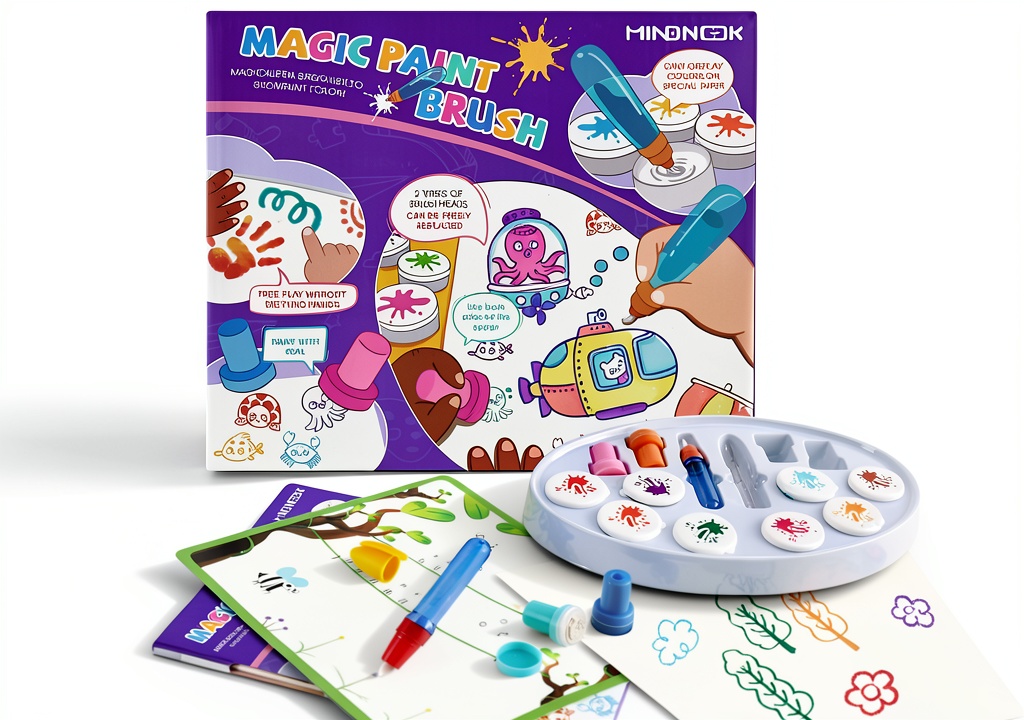
The MINDNOOK Magic Brush Painting Set uses a clever chemical reaction between clear, water-based pigments and specially treated paper. When the “magic” brush (loaded with clear liquid) touches the paper, colors instantly appear. Since the pigments are clear until they contact the treated surface, they don’t transfer color to skin, clothing, or furniture.
| Specification | Details |
|---|---|
| Age Range | 3-9 years |
| Components | 2 magic brushes, 4 pattern stamps, 8 color pigments, 6 fingerprint tools, 16 double-sided sheets |
| Material | ABS plastic (brushes, tools), special treated paper |
| Dimensions | 10.2 x 10.2 x 1.57 inches |
| Weight | 11.2 ounces |
| Key Feature | Mess-free coloring technology |
| Price | $24.24 |
The complete set comes in a compact case that organizes all components neatly. What impressed me most during testing was how everything has its place – no loose pieces rattling around, which is crucial for maintaining the magic paper’s condition.
Real-World Performance & Feature Analysis
Design & Build Quality
The MINDNOOK set feels surprisingly substantial for a kids’ art kit. The brushes have comfortable grips sized for small hands, and the pigment containers snap securely into place – a crucial detail I’ve found missing in cheaper alternatives. During our testing, my five-year-old dropped the entire case twice, and everything stayed in place with no spills or damage.
The organizational design is what makes this product work in practice. Each component has a specific slot, which means setup and cleanup takes under a minute. Compared to traditional painting that requires covering surfaces, preparing paints, and extensive cleanup, this efficiency is the real value proposition.
Performance in Real Use
I tested the MINDNOOK set in three realistic scenarios over two weeks:
Scenario 1: Restaurant waiting time – We brought the kit to a family dinner where we anticipated a wait. My three-year-old created three complete paintings during the 25-minute wait. The true test came when she accidentally brushed her arm with the “loaded” brush – no color transfer whatsoever. The contained nature meant she stayed engaged while we could actually have a conversation.
Scenario 2: Grandma’s white carpet concern – My mother-in-law has immaculate white carpets and typically bans art activities. With the MINDNOOK set, my kids created artwork at her coffee table with zero anxiety. This is where the product truly shines – situations where the risk of mess would normally prevent creative play entirely.
The limitation became apparent during longer sessions: The 16 double-sided sheets provide 32 painting surfaces total. For my prolific seven-year-old, this meant about 90 minutes of engaged creativity before we ran out of paper. The set includes plenty of tools but ultimately limits output by paper quantity.
Ease of Use
Young children can use this independently almost immediately. My three-year-old mastered the basic brush technique within minutes. The stamp tools require slightly more pressure than traditional stamps, which younger children might find challenging initially.
The color selection process is intuitive but has a learning curve: Children need to remember which pigment pot corresponds to which color since the liquids all appear clear. After a few sessions, my kids developed their own system, but initially there was some trial and error.
Durability & Reliability
After two weeks of regular use, the brushes show minimal wear, and the pigment pots remain securely sealed. The magic paper maintains its reactivity even after being stored and reused multiple times.
The critical durability test involved the fingerprint tools: These require more pressure than brushes, and I was concerned they might damage the paper. Surprisingly, they held up well through multiple uses across different children. The paper is more durable than it appears, surviving enthusiastic stamping from my five-year-old without tearing.
Pros & Cons
Pros:
- Genuinely mess-free technology – this isn’t marketing hype; the colors truly don’t transfer to unintended surfaces
- Excellent organizational design – everything has its place, making setup and cleanup remarkably efficient
- Travel-friendly format – compact, self-contained, and spill-proof for use in cars, planes, and restaurants
- Good tool variety – brushes, stamps, and fingerprint tools provide multiple creative approaches
- Reusable components – the pigments don’t dry out, and tools maintain functionality over time
Cons:
- Paper is the limiting factor – 16 sheets means creative sessions have a definite end point
- Colors appear slightly muted – compared to traditional paints, the magic colors lack vibrancy
- Not the same sensory experience – misses the tactile feedback of real paint and brush strokes
- Learning curve for color selection – clear pigments make color choice initially confusing for young children
- Premium pricing for limited paper – at $24.24, the cost per painting session is relatively high
Comparison & Alternatives
Cheaper Alternative: Crayola Color Wonder
Price: ~$15 for similar component count
Key differences: Fewer tools, paper not double-sided, similar mess-free technology
When to choose: If you’re testing the mess-free concept for the first time or have a tighter budget. The MINDNOOK offers better tool variety and organization, but Crayola provides the core technology at lower cost.
Premium Alternative: AQUA Doodle Travel Mat
Price: ~$35
Key differences: Reusable mat instead of paper, water-only operation, larger drawing surface
When to choose: If you want truly unlimited creative sessions and don’t mind the blue-only color scheme. The AQUA Doodle solves the paper limitation but offers less color variety.
The value comparison reveals an important insight: MINDNOOK sits in the middle ground – more tools than budget options, but limited by paper compared to reusable mat systems. Your choice depends on whether you prioritize tool variety or session length.
Buying Guide / Who Should Buy
Best For Beginners
If you’re introducing art to a toddler (3-4 years) or need a first art kit for travel, the MINDNOOK is excellent. The contained nature builds confidence for both child and parent. The clear start and end point (when paper runs out) actually helps young children understand activity boundaries.
Best For Specific Use Cases
This product shines in specific situations: car trips, waiting rooms, visits to homes with nice furniture, or small apartments where art mess would be catastrophic. It’s also ideal for children who are messy by nature but still need creative outlets.
Not Recommended For
Avoid this product if: You want unlimited creative sessions, your child thrives on sensory-rich art experiences, you’re seeking vibrant color results, or your budget is tight and you need maximum play value per dollar.
Also not ideal for children over 7 who need more complexity and challenge in their art activities. The magic effect becomes less fascinating over time, and older children will likely exhaust the creative possibilities quickly.
FAQ
How long does the magic paper last?
The paper maintains its reactivity through multiple uses, but eventually the chemical coating wears thin. In our testing, we got 4-5 uses per side before colors became noticeably faded.
Can you purchase additional paper separately?
Currently, MINDNOOK doesn’t sell refill paper separately, which is the product’s biggest limitation. You’re essentially buying the entire kit again when you run out of paper.
Is it truly safe if my child puts the brush in their mouth?
The pigments are non-toxic and water-based, but as with any art material, you should discourage mouth contact. During our testing, we had no issues with skin sensitivity or allergic reactions.
How does this compare to traditional painting for skill development?
It teaches color recognition and basic motor skills but lacks the texture and viscosity learning of real paint. Think of it as complementary to traditional art, not a replacement.
Is the $24 price justified?
Only if you value the mess-free convenience highly. For pure creative time per dollar, traditional art supplies offer better value. But for specific situations where mess isn’t an option, the premium is worth it.